Abstract Algebra: The Mathematics of Symmetry
Groups: distilling the essence of symmetry#
Look at what the integers-under-addition, the nonzero-reals-under-multiplication, the rotations of a square, and the shuffles of a deck of cards have in common: a set with one operation that is associative, has an identity element, and gives every element an inverse. Extract exactly those properties and you have a group — the most successful abstraction in algebra.
\text{A group } (G, *): \quad \begin{cases} a * (b * c) = (a * b) * c & \text{(associativity)}\\ \exists\, e: \; e * a = a * e = a & \text{(identity)}\\ \forall a\; \exists\, a^{-1}: \; a * a^{-1} = e & \text{(inverses)} \end{cases}
Commutativity (a*b = b*a) is not required; groups that have it are called abelian. The rotations-and-flips of a square form the non-abelian group D_4 (rotate-then-flip differs from flip-then-rotate — try it with a book):
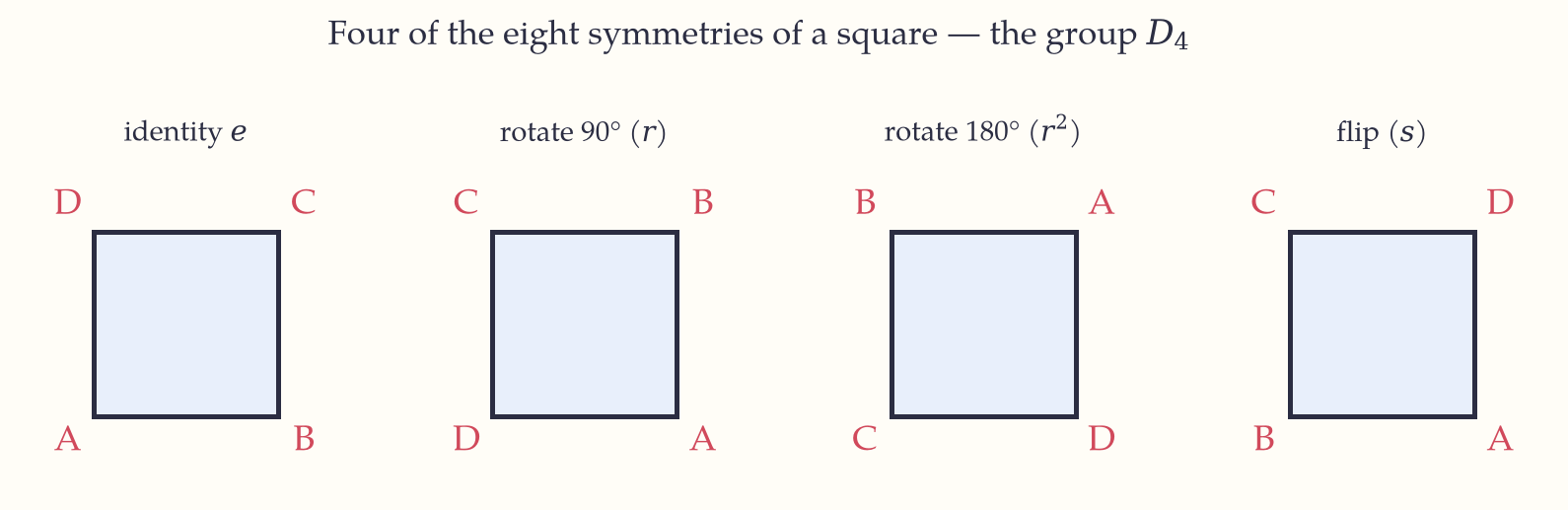
Other citizens of the group world: (\mathbb{Z}, +); the integers mod n under addition, \mathbb{Z}_n (clock arithmetic); the invertible n\times n matrices under multiplication; the symmetric group S_n of all n! permutations of n objects. Group theory is, at heart, the mathematics of symmetry — and via that, of crystal structures, particle physics, error-correcting codes, and the unsolvability of the quintic.
The theorems that organize everything#
A subgroup is a group living inside a group (\{e, r^2\} inside D_4; the even integers inside \mathbb{Z}). The order of a finite group is its size; the order of an element a is the least n with a^n = e.
Lagrange’s Theorem. In a finite group, the order of any subgroup divides the order of the group.
The proof idea is lovely: a subgroup H tiles the whole group into equal-sized copies (cosets), so |H| must divide |G|. Consequences cascade: the order of every element divides |G|; every group of prime order is cyclic (generated by a single element) with no interesting subgroups at all; and Fermat’s little theorem, a^{p-1} \equiv 1 \pmod p, is Lagrange applied to the multiplicative group mod p.
Abstraction earns its keep only when you can watch it work, so run Lagrange on a group small enough to see whole: \mathbb{Z}_6 = \{0,1,2,3,4,5\} under addition mod 6. The order of an element is how many times you must add it to itself to return to 0:
\begin{aligned} 1:\ &1,2,3,4,5,0 \\ &\quad \text{order } 6\\ 2:\ &2,4,0 \\ &\quad \text{order } 3\\ 3:\ &3,0 \\ &\quad \text{order } 2\\ 4:\ &4,2,0 \\ &\quad \text{order } 3\\ 5:\ &5,4,3,2,1,0 \\ &\quad \text{order } 6\\ 0:\ &0 \\ &\quad \text{order } 1 \text{ (the identity)} \end{aligned}
Every order that appeared — 1, 2, 3, 6 — divides 6, exactly as Lagrange promises, and the orders 4 and 5 are simply impossible in a group of this size. That is the theorem’s real power: it rules things out before you go looking. Notice too that 1 and 5 each generate the whole group by themselves, which is what makes \mathbb{Z}_6 cyclic.
Now the same theorem in disguise. Take the nonzero elements mod 7 under multiplication — a group of order 6. Lagrange says every element’s order divides 6, so a^6 = 1 for every a \not\equiv 0. Written out, that is a^{6} \equiv 1 \pmod 7: Fermat’s little theorem, which underwrites primality testing and RSA encryption, falling out as a special case of a fact about cosets. This is the characteristic pleasure of abstract algebra — prove something once about all groups, and collect the consequences everywhere.
A homomorphism is a map between groups that respects the operation, \varphi(ab) = \varphi(a)\varphi(b); an isomorphism is a bijective one, and isomorphic groups are the same group in different clothing. The classification instinct — “list all groups of order n, up to isomorphism” — drives a century of algebra, culminating in the monumental classification of finite simple groups.
Rings and fields: two operations#
Add a second operation and richer structures appear:
- A ring has addition and multiplication with the familiar laws (associativity, distributivity), like \mathbb{Z} or polynomials \mathbb{R}[x] or n \times n matrices. Multiplicative inverses are not promised.
- A field is a ring where every nonzero element has a multiplicative inverse: \mathbb{Q}, \mathbb{R}, \mathbb{C} — and, crucially, \mathbb{Z}_p for prime p.
That last example deserves a pause: arithmetic mod a prime forms a complete miniature universe with all four operations. And since primes are now load-bearing, two jewels of elementary number theory belong here. First, there are infinitely many primes — Euclid’s proof, circa 300 BC, still the standard of elegance: suppose the primes were a finite list p_1, p_2, \dots, p_k; form N = p_1p_2\cdots p_k + 1. Dividing N by any listed prime leaves remainder 1, so no listed prime divides N — yet N, like every integer above 1, must have some prime factor. That factor is a prime missing from the “complete” list: contradiction. \blacksquare Second, the Euclidean algorithm computes the greatest common divisor by repeated remainders — \gcd(252, 105): 252 = 2\cdot105 + 42, then 105 = 2\cdot42 + 21, then 42 = 2\cdot21 + 0, so \gcd = 21 — and runs in a flash even on thousand-digit numbers, which is exactly why RSA key generation is feasible while the reverse problem (factoring) is not. The oldest algorithm still in daily production use. Why prime? Because mod 6, we have 2 \times 3 = 0 with neither factor zero — “zero divisors” that wreck division. Mod a prime this cannot happen, and every nonzero element becomes invertible. Finite fields \mathbb{Z}_p power modern cryptography (RSA, Diffie–Hellman, elliptic curves): the entire security of online banking rests on Chapter-19 algebra.
The vector spaces of Chapter 16 secretly required a field all along — the scalars. Linear algebra over \mathbb{Z}_2 (bits!) is coding theory; the abstractions interlock.
In the wild. RSA encryption is Lagrange’s theorem in the group (\mathbb{Z}_n^*, \times); Diffie–Hellman key exchange hides secrets in the difficulty of undoing exponentiation in \mathbb{Z}_p^*; the newest post-quantum schemes live in lattices and rings. Error-correcting codes (QR codes, deep-space probes, RAM) are linear algebra over finite fields. Chemistry classifies crystals by their symmetry groups; particle physics predicts particles from group representations — the “eightfold way” found the omega-minus before any detector did.
If you keep one thing from this chapter: A group is symmetry distilled to three axioms. Primes make \mathbb{Z}_p a field — and that modest fact is the arithmetic guarding every encrypted connection you make.
Exercises 19
- Verify that \mathbb{Z}_5 \setminus \{0\} under multiplication mod 5 is a group; find the order of each element.
- Show that the identity element of a group is unique, and inverses are unique.
- List all subgroups of \mathbb{Z}_{12} and check each order divides 12.
- Is (\mathbb{Z}, \times) a group? Is (\mathbb{Q}\setminus\{0\}, \times)? Explain precisely which axiom fails, if any.
- Prove that in any group, (ab)^{-1} = b^{-1}a^{-1} (the “socks and shoes” law).