Complex Numbers
The last great extension#
The equation x^2 = -1 has no real solution — so, in the grand tradition of Chapter 1, we invent one: a number i with i^2 = -1. Historically, the push came not from quadratics — those one could simply declare unsolvable — but from cubics: Cardano’s 1545 solution formula sometimes produced square roots of negatives in the middle of computing a perfectly real answer, and Bombelli discovered that if you calmly calculated with them, the imaginary parts cancelled and the true root emerged. Complex numbers were admitted to mathematics not as a fancy but as scaffolding that visibly worked. A complex number is z = a + bi; its conjugate is \bar z = a - bi; its modulus is |z| = \sqrt{a^2 + b^2}. Arithmetic proceeds exactly as with binomials, replacing i^2 by -1:
(2 + 3i)(1 - i) = 2 - 2i + 3i - 3i^2 = 5 + i.
To divide, multiply top and bottom by the conjugate: \frac{1}{a+bi} = \frac{a - bi}{a^2 + b^2}. The move deserves a slow walk, because it is the one piece of complex arithmetic that looks like a trick and is not:
\begin{aligned}\frac{3 + 4i}{1 - 2i} &= \frac{3+4i}{1-2i}\cdot\frac{1+2i}{1+2i} \\ &\quad \text{multiply by } \tfrac{\bar w}{\bar w} = 1 \text{ — legal, and it clears the bottom} \\ &= \frac{(3+4i)(1+2i)}{(1-2i)(1+2i)} \\ &\quad \text{the denominator is now } w\bar w = |w|^2, \text{ a real number} \\ &= \frac{3 + 6i + 4i + 8i^2}{1 + 4}\end{aligned}
expand; the cross terms cancel below, never above
\begin{aligned}&= \frac{-5 + 10i}{5} = -1 + 2i. \\ &\quad \text{divide through — back to the form } a+bi\end{aligned}
Why a conjugate and not something else? Because w\bar w = a^2 + b^2 is the one product that kills the imaginary part outright. Rationalizing \frac{1}{\sqrt2 - 1} by multiplying by \sqrt2 + 1 is the same manoeuvre in a different costume: pair a number with its conjugate and the awkward part cancels.
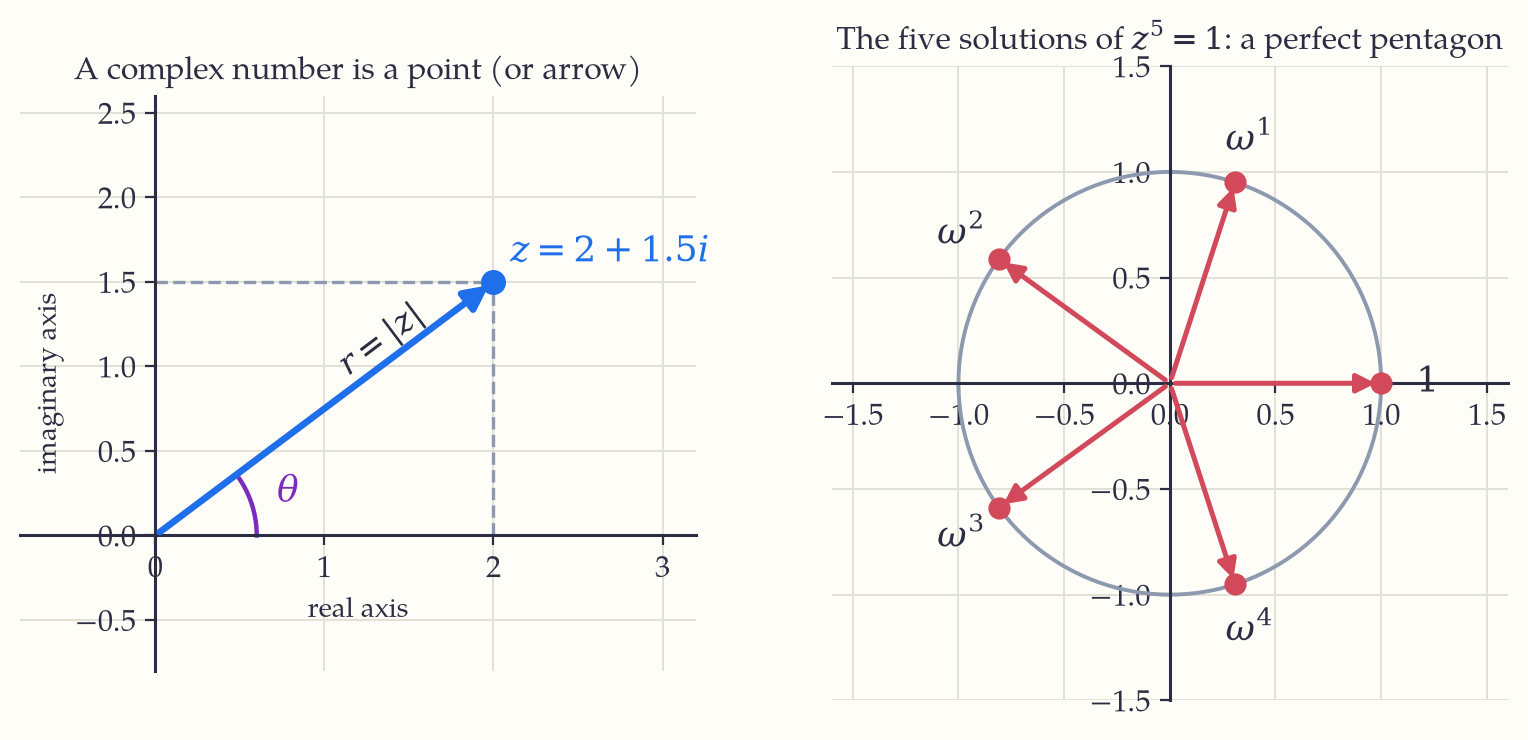
Far from being “imaginary,” complex numbers are simply points in a plane — the real axis horizontal, the imaginary axis vertical:
Polar form: where the magic lives#
A point can also be addressed by distance and direction: z = r(\cos\theta + i\sin\theta), where r = |z| and \theta = \arg z. Euler’s formula compresses this to the most celebrated identity in mathematics:
\begin{aligned}e^{i\theta} = \cos\theta + i\sin\theta \\ \Longrightarrow \\ e^{i\pi} + 1 = 0.\end{aligned}
Key idea. In polar form, multiplication becomes geometry: multiply the lengths, add the angles. Multiplying by i is a pure 90° rotation. Complex numbers are the algebra of rotation — which is why they run electrical engineering, quantum mechanics, and signal processing.
Converting to polar form is worth doing once by hand, because the picture does most of the work. Take z = 1 + i:
\begin{aligned}r = |z| &= \sqrt{1^2 + 1^2} = \sqrt2\end{aligned}
distance from the origin — Pythagoras, nothing more
\begin{aligned}\theta = \arg z &= \arctan\tfrac{1}{1} = \tfrac{\pi}{4} \\ &\quad \text{the point sits on the diagonal, so } 45° \\ \Rightarrow\quad z &= \sqrt2\,e^{i\pi/4}.\end{aligned}
same number, addressed by distance and direction
Now watch what polar form buys you. Computing (1+i)^8 by multiplying binomials eight times is a miserable afternoon; in polar form it is one line:
(1+i)^8 = \left(\sqrt2\,e^{i\pi/4}\right)^8 = (\sqrt2)^8 e^{i2\pi} = 16\cdot 1 = 16.
The length gets raised to the power, the angle gets multiplied by it — and 8 \times 45° = 360° lands exactly back on the positive real axis. That is not a coincidence engineered for the example; it is what powers of complex numbers always do, which is the content of the next theorem.
Repeated multiplication gives De Moivre’s theorem, \big(r e^{i\theta}\big)^n = r^n e^{in\theta}, and running it backwards finds roots: the n-th roots of unity are
\begin{aligned}z = e^{2\pi i k/n}, \\ k = 0, 1, \dots, n-1\end{aligned}
— n points evenly spaced around the unit circle, a perfect regular polygon (see the pentagon in the figure above). Every polynomial of degree n has exactly n complex roots (the Fundamental Theorem of Algebra): with \mathbb{C}, the tower of number systems from Chapter 1 is finally complete. No equation ever forces another extension.
In the wild. Alternating current is analyzed entirely in complex numbers (impedance is complex; the phase is the argument). The Fast Fourier Transform — arguably the most-executed nontrivial algorithm on Earth, inside every phone call, image, and Wi-Fi packet — is a clever dance among roots of unity, the pentagon picture above generalized to n = 2^{20}. Quantum mechanics does not merely use complex numbers; its states essentially are complex vectors.
If you keep one thing from this chapter: A complex number is a point in the plane, and multiplication is rotation. That single geometric fact runs signal processing, AC circuits, and quantum mechanics.
Exercises 11
- Compute \dfrac{3 + 4i}{1 - 2i} in the form a + bi. (Worked in this chapter — close the book and do it from memory first, then compare.)
- Find the modulus and argument of z = -1 + i\sqrt{3}, and write z in polar form.
- Use De Moivre to compute (1 + i)^{10}.
- Find all cube roots of 8i.
- Show that |z_1 z_2| = |z_1||z_2| using polar form.