Trigonometry
From triangles …#
In a right triangle with angle \theta, the three classical ratios are
\begin{aligned}\sin\theta = \frac{\text{opposite}}{\text{hypotenuse}}, \\ \cos\theta = \frac{\text{adjacent}}{\text{hypotenuse}}, \\ \tan\theta = \frac{\text{opposite}}{\text{adjacent}} = \frac{\sin\theta}{\cos\theta}.\end{aligned}
These ratios depend only on the angle, not the triangle’s size — that similarity is the whole secret of trigonometry’s power. Underneath sits the theorem of Pythagoras, and it deserves to be seen, not just recited:
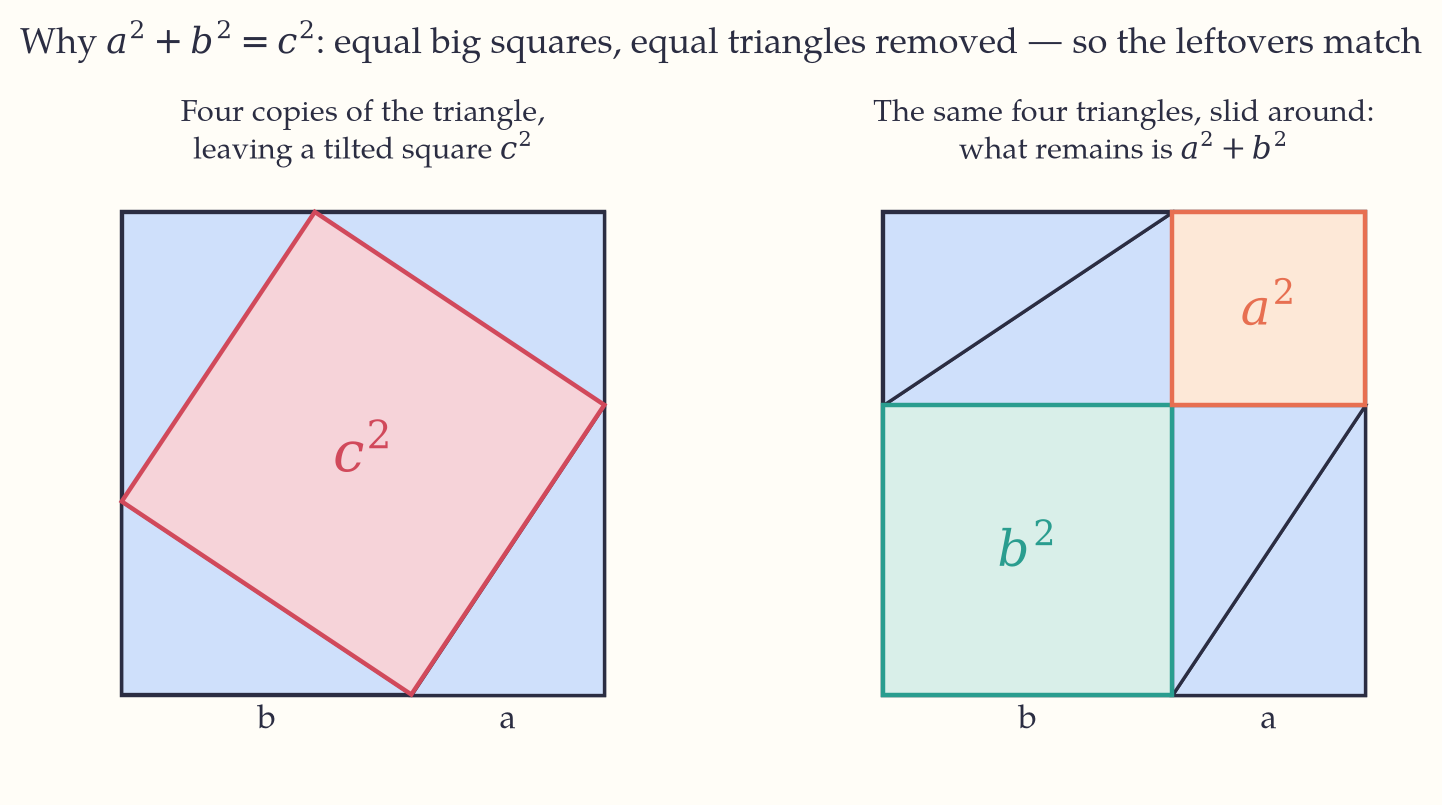
Both big squares have side a+b; remove four identical triangles from each, and the leftovers — c^2 on the left, a^2 + b^2 on the right — must be equal.
The angles worth memorizing (all others are a calculator’s job):
| \theta | 0° | 30° | 45° | 60° | 90° |
|---|---|---|---|---|---|
| \sin\theta | 0 | \frac{1}{2} | \frac{\sqrt2}{2} | \frac{\sqrt3}{2} | 1 |
| \cos\theta | 1 | \frac{\sqrt3}{2} | \frac{\sqrt2}{2} | \frac{1}{2} | 0 |
… to the circle#
Triangles cap angles at 90°. To free trigonometry, redefine: place the angle at the center of a unit circle, and let
\begin{aligned}\cos\theta = x\text{-coordinate}, \\ \sin\theta = y\text{-coordinate}\end{aligned}
of the point where the angle’s ray meets the circle. Now every angle — obtuse, negative, beyond 360° — has a sine and cosine.
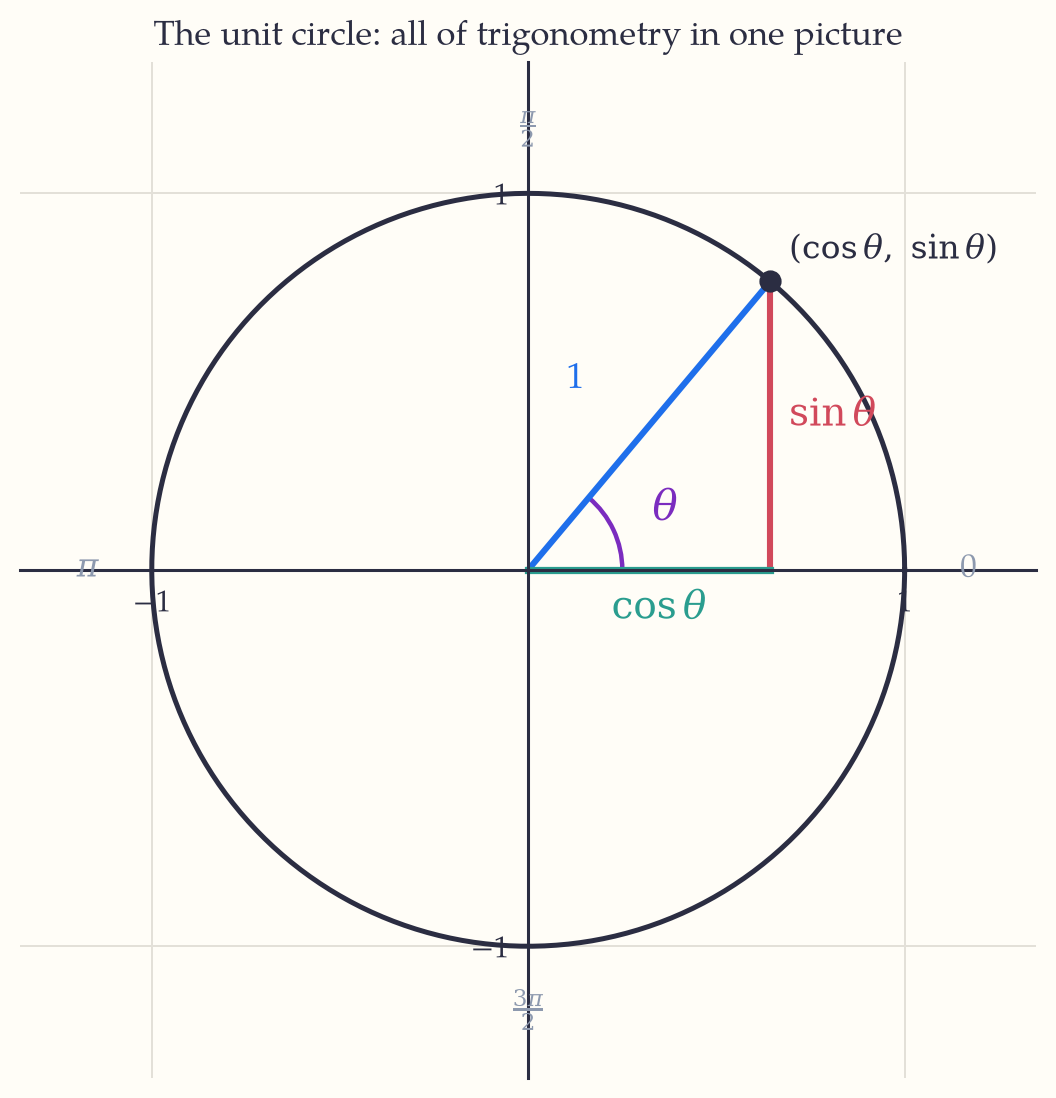
From this one picture, the essential facts fall out for free:
- \sin^2\theta + \cos^2\theta = 1 — Pythagoras on the unit circle.
- \sin(-\theta) = -\sin\theta, \cos(-\theta) = \cos\theta — reflect across the x-axis.
- Both repeat every full turn: period 2\pi.
Radians measure angles by arc length along the unit circle: a full turn is 2\pi, so 180° = \pi. Radians are not a stylistic preference — they are the units in which calculus works (\frac{d}{dx}\sin x = \cos x is true only in radians).
Unrolling the circle turns rotation into oscillation:
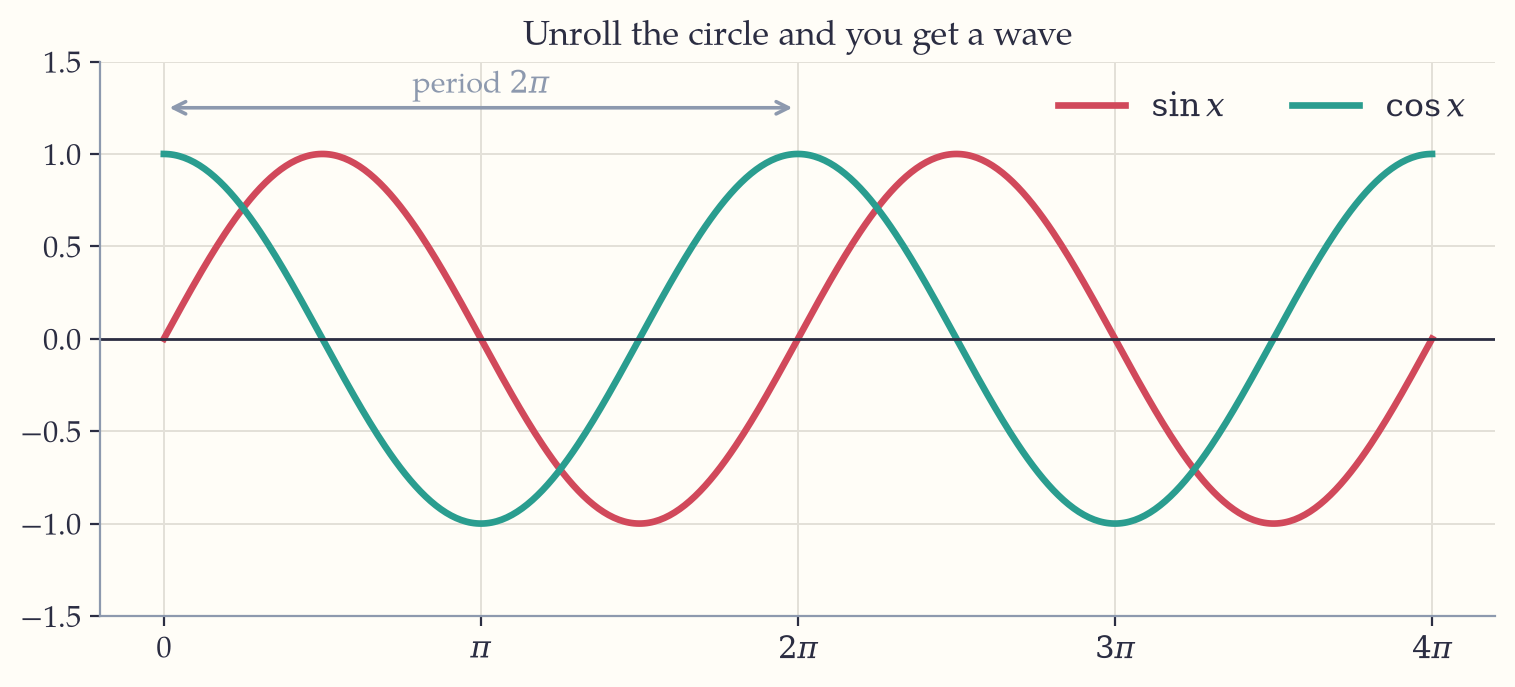
The general wave y = A\sin(bx + \varphi) has amplitude A, period \frac{2\pi}{b}, and phase shift set by \varphi — the vocabulary of sound, light, tides, and alternating current.
The identities that matter#
Everything flows from the addition formulas:
\begin{aligned}\sin(A \pm B) = \sin A\cos B \pm \cos A \sin B, \\ \cos(A \pm B) = \cos A\cos B \mp \sin A \sin B.\end{aligned}
Set A = B to get the double angles:
\begin{aligned}\sin 2A = 2\sin A\cos A, \\ \cos 2A = \cos^2\!A - \sin^2\!A = 2\cos^2\!A - 1 = 1 - 2\sin^2\!A.\end{aligned}
For triangles that aren’t right-angled, two laws handle everything. In a triangle with sides a,b,c opposite angles A,B,C:
\begin{aligned}\textbf{Sine rule: } \frac{a}{\sin A} = \frac{b}{\sin B} = \frac{c}{\sin C} \\ \textbf{Cosine rule: } c^2 = a^2 + b^2 - 2ab\cos C.\end{aligned}
The cosine rule is Pythagoras with a correction term for the bent angle — set C = 90° and it collapses back to c^2 = a^2 + b^2.
Running trigonometry backwards: the inverse functions#
“The sine of what angle is 0.5?” is a question about an inverse function (Chapter 3). But \sin repeats forever, so infinitely many angles qualify; to get a genuine function we restrict to one agreed window of angles — the principal values:
\begin{aligned} \sin^{-1}x &\in \left[-\tfrac{\pi}{2}, \tfrac{\pi}{2}\right] && (x \in [-1,1])\\ \cos^{-1}x &\in [0, \pi] && (x \in [-1,1])\\ \tan^{-1}x &\in \left(-\tfrac{\pi}{2}, \tfrac{\pi}{2}\right) && (x \in \mathbb{R}) \end{aligned}
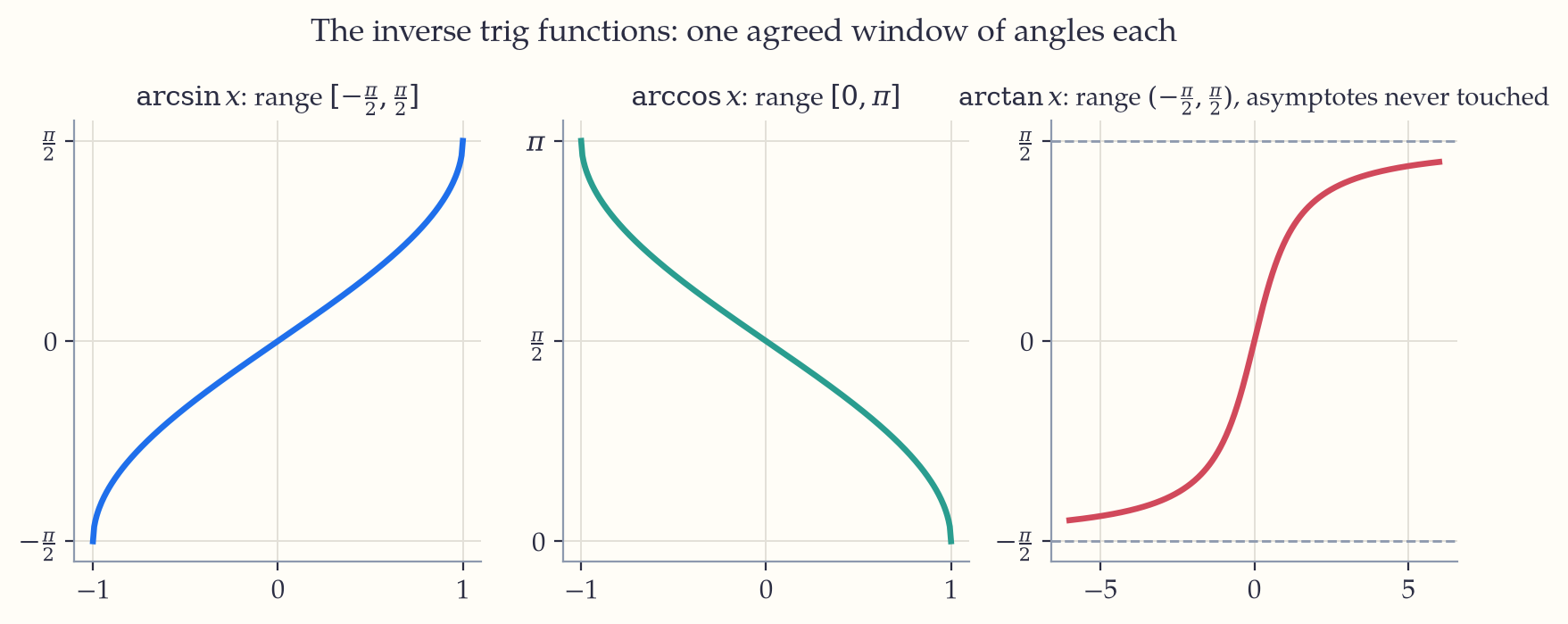
So \sin^{-1}\frac12 = \frac{\pi}{6}
(not \frac{5\pi}{6}, though that angle
also has sine \frac12 — it lies outside
the window). The notation \sin^{-1}
means the inverse function, never \frac{1}{\sin}; the unambiguous names \arcsin, \arccos, \arctan are safer and we
use them interchangeably. \arctan is
the quiet star: it converts a slope back into an angle (every time code
calls atan2(y, x) to point a game character at a target,
this is it), and in Chapter 14’s world it owns one of the most pleasing
derivative facts in calculus,
\begin{aligned}\frac{d}{dx}\arctan x = \frac{1}{1+x^2},\end{aligned}
hence
\begin{aligned}\int \frac{dx}{1+x^2} = \arctan x + C,\end{aligned}
which is why \arctan keeps materializing inside integrals that contain no trigonometry at all — and why 4\arctan 1 = \pi underlies classical computations of \pi.
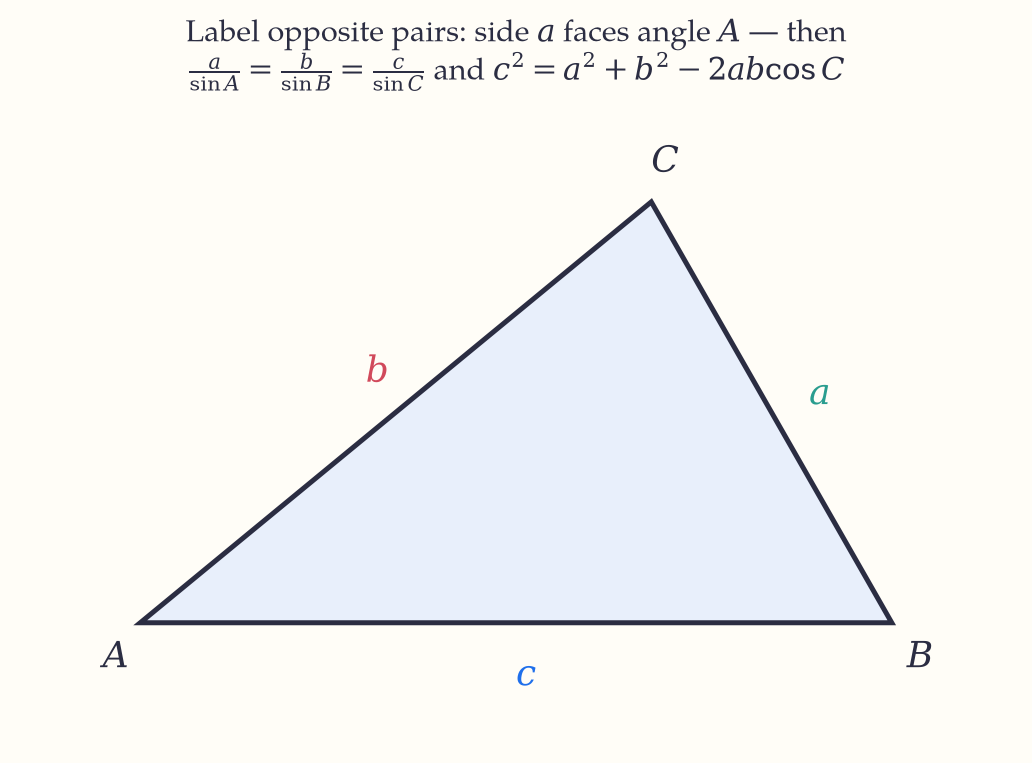
Worked example (surveying without crossing the river). From two points A, B on one bank, 100 m apart, a tree C across the river is sighted at angles A = 62° and B = 71°. The angles of a triangle sum to 180°, so C = 47°. The sine rule (side a = BC is opposite angle A, and side c = AB = 100 is opposite C) gives \frac{a}{\sin A} = \frac{c}{\sin C}, so a = \frac{100\sin 62°}{\sin 47°} \approx 120.7 m; the tree’s perpendicular distance from the bank is then a\sin B = 120.7 \sin 71° \approx 114 m. Triangulation — this exact computation — mapped India in the 1800s (the Great Trigonometrical Survey that measured Everest) and lives on inside every GPS receiver.
In the wild. Sines and cosines are the atoms of every signal: Fourier analysis (a BSc sequel to this book) decomposes sound, images, and radio into pure waves — JPEG, MP3, MRI, and 5G are trigonometry at industrial scale. Game engines burn through \sin and \cos every frame to rotate the world, and the rotation matrix of Exercise 12.5 is how.
If you keep one thing from this chapter: All of trigonometry is one picture: the point (\cos\theta, \sin\theta) walking the unit circle. Unroll the walk and you get every wave in physics.
Exercises 6
- Convert 150° to radians and \frac{5\pi}{4} to degrees; find the sine and cosine of each.
- Prove \dfrac{1 - \cos 2\theta}{\sin 2\theta} = \tan\theta.
- Solve 2\sin^2 x - \sin x - 1 = 0 for 0 \le x < 2\pi.
- A triangle has sides 5 and 8 enclosing an angle of 60°. Find the third side and the area.
- Sketch y = 3\sin\!\big(2x - \frac{\pi}{2}\big), stating amplitude, period, and phase shift.
- Evaluate \arcsin\frac{\sqrt3}{2}, \ \arccos\left(-\frac12\right), and \arctan(-1), respecting principal values; then simplify \cos\!\big(\arcsin x\big) using a right triangle.