Coordinate Geometry and the Conic Sections
Geometry with an address system#
Descartes’ great trick: give every point an address (x, y), and geometry becomes algebra. Three formulas run the whole subject — for points P_1(x_1,y_1) and P_2(x_2,y_2):
\begin{aligned}\text{distance} = \sqrt{(x_2-x_1)^2 + (y_2-y_1)^2}, \\ \text{midpoint} = \left(\frac{x_1+x_2}{2},\, \frac{y_1+y_2}{2}\right),\end{aligned}
and the slope m = \frac{y_2-y_1}{x_2-x_1} from Chapter 3. The distance formula is Pythagoras, wearing coordinates.
A circle is the set of points at fixed distance r from a center (h,k) — so its equation is the distance formula squared:
(x-h)^2 + (y-k)^2 = r^2.
Circles rarely arrive in that tidy form, though. Expanded and shuffled, x^2 + y^2 - 6x + 4y - 12 = 0 hides its centre and radius completely — until you complete the square from Chapter 4, once in x and once in y:
\begin{aligned}x^2 - 6x + y^2 + 4y &= 12 \\ &\quad \text{group the } x\text{'s and } y\text{'s, constant to the right} \\ (x^2 - 6x + 9) + (y^2 + 4y + 4) &= 12 + 9 + 4 \\ &\quad \text{add } (\tfrac{-6}{2})^2 = 9 \text{ and } (\tfrac{4}{2})^2 = 4 \text{ — to both sides} \\ (x-3)^2 + (y+2)^2 &= 25\end{aligned}
each bracket is now a perfect square
\begin{aligned}\Rightarrow\quad \text{centre } (3,-2),\ &\ \text{radius } 5.\end{aligned}
read straight off the standard form
That is the whole method, and it generalizes: whenever a conic appears with linear terms in x or y, completing the square is what moves it back to the origin so you can recognize it. The same move that found a parabola’s vertex now finds a circle’s centre.
The conic sections#
Slice a double cone with a plane and, depending on the tilt, you get a circle, an ellipse, a parabola, or a hyperbola. Each is also a locus — a set of points obeying a distance rule:
| Conic | Distance definition | Standard equation |
|---|---|---|
| Circle | fixed distance from a center | x^2 + y^2 = r^2 |
| Ellipse | distances to two foci sum to a constant | \frac{x^2}{a^2} + \frac{y^2}{b^2} = 1 |
| Parabola | equidistant from a focus and a line | y^2 = 4ax |
| Hyperbola | distances to two foci differ by a constant | \frac{x^2}{a^2} - \frac{y^2}{b^2} = 1 |
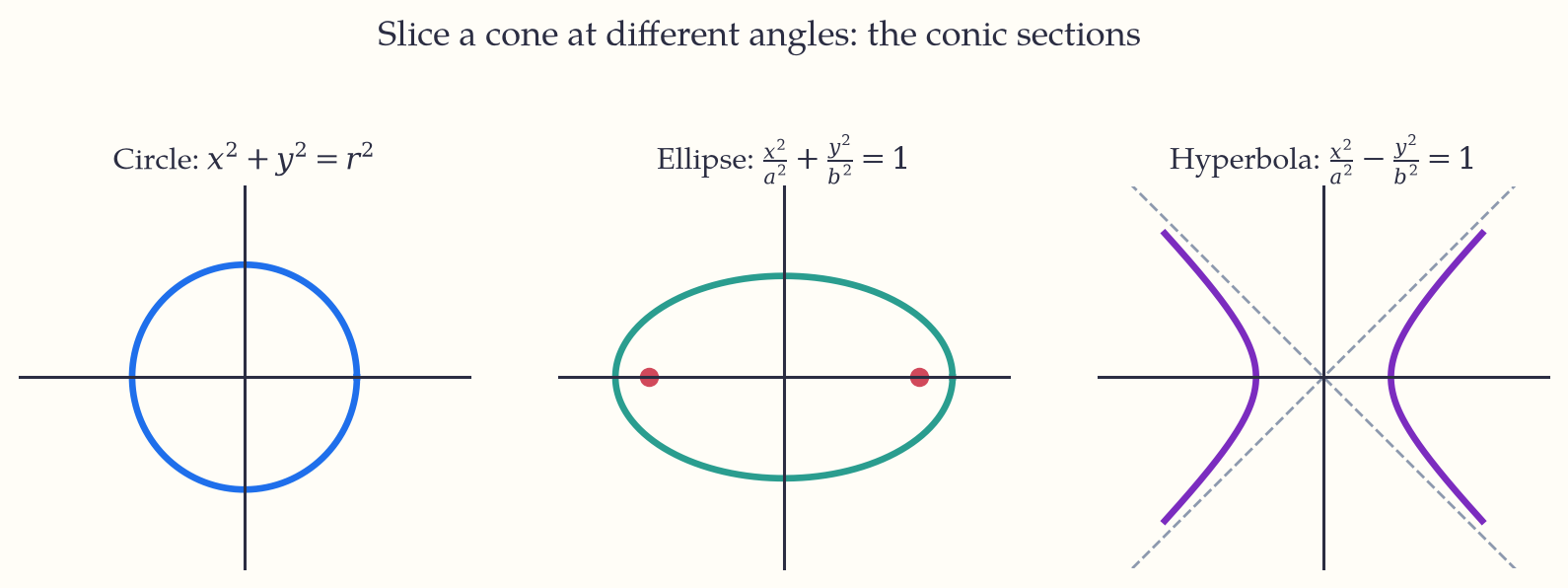
For the ellipse, the foci sit at (\pm c, 0) with c^2 = a^2 - b^2; eccentricity e = c/a measures the squash, from 0 (circle) toward 1 (cigar). Planets orbit in ellipses with the sun at one focus — Kepler’s discovery, and the conics’ finest hour. The hyperbola alone has asymptotes, y = \pm\frac{b}{a}x: lines it approaches forever but never touches.
A quick worked reading of an ellipse, since the letters trip people up. For \frac{x^2}{25} + \frac{y^2}{9} = 1: the larger denominator sits under x, so the long axis is horizontal with a = \sqrt{25} = 5 and b = \sqrt 9 = 3. Then c^2 = a^2 - b^2 = 25 - 9 = 16, so c = 4: the foci are at (\pm 4, 0) and the eccentricity is e = c/a = 4/5 = 0.8 — noticeably squashed. Two guards against the classic error: a is always the larger of the two, and c is smaller than a, because the foci must live inside the curve. If your arithmetic gives c > a, you have subtracted the wrong way round.
The parabola’s private superpower is its reflection property: rays arriving parallel to the axis all bounce through the focus — hence satellite dishes, headlights, and telescope mirrors.
In the wild. Planetary orbits are ellipses; spacecraft on escape trajectories fly hyperbolas; GPS positioning intersects spheres and hyperbolas of constant time-difference. Closer to daily life: the “circle” (x-h)^2 + (y-k)^2 \le r^2 is how an app answers “restaurants within 2 km”, and collision detection in games tests exactly such inequalities millions of times per second.
If you keep one thing from this chapter: Coordinates turn geometry into algebra: distance is Pythagoras in disguise, a circle is an equation, and the four conics are one cone sliced at four angles.
Exercises 7
- Find the center and radius of x^2 + y^2 - 6x + 4y - 12 = 0 (complete the square twice). (Worked in this chapter — close the book and do it from memory first, then compare.)
- Find the equation of the circle with diameter endpoints (1, 2) and (5, -4).
- For the ellipse \frac{x^2}{25} + \frac{y^2}{9} = 1, find the foci and eccentricity. (Worked in this chapter — close the book and do it from memory first, then compare.)
- Find the focus and directrix of y^2 = 12x.
- Show that the point where the line y = x + 1 meets y^2 = 4x is a single point of tangency.