Algebra: The Grammar of Mathematics
Letters as numbers-in-waiting#
Algebra is arithmetic with the specific numbers removed. When we write x + x = 2x, we assert something true for every number at once — algebra is the technology of saying infinitely many things in one breath.
Three kinds of statements look alike but behave differently:
- An identity is true for all values: (x+1)^2 = x^2 + 2x + 1.
- An equation is true for some values, and asks you to find them: x^2 = 9.
- A formula relates quantities: A = \pi r^2.
The expansions and factorizations you must know cold#
\begin{aligned} (a+b)^2 &= a^2 + 2ab + b^2 \\ (a-b)^2 &= a^2 - 2ab + b^2 \\ (a+b)(a-b) &= a^2 - b^2 \\ (a+b)^3 &= a^3 + 3a^2b + 3ab^2 + b^3 \\ a^3 \pm b^3 &= (a \pm b)(a^2 \mp ab + b^2) \end{aligned}
The difference of squares a^2 - b^2 = (a+b)(a-b) is the single most-used factorization in all of mathematics. Reading it right to left is expanding; reading it left to right is factoring — and factoring is how equations get solved, because of one golden fact:
The zero-product principle. If A \cdot B = 0 then A = 0 or B = 0. This is why we factor: it converts one hard equation into several easy ones. It works because zero is the only number with this property: AB = 1 certainly does not force A = 1 or B = 1. (Zero’s other famous rule has a different reason: division by zero is forbidden because nothing multiplied by zero can give one, so zero has no reciprocal to divide by.)
Solving linear equations and systems#
The word algebra comes from al-jabr (“restoration”), from the title of a 9th-century Baghdad textbook by al-Khwarizmi — whose own name, Latinized, became algorithm. His method survives unchanged: an equation is a balanced scale, and you may do anything to it that you do to both sides, until the unknown stands alone. Every step below names its move:
\begin{aligned}5x - 7 &= 2x + 8\end{aligned}
the equation
\begin{aligned}5x - 7 - 2x &= 8 \\ &\quad \text{subtract } 2x \text{ from both sides (collect the } x\text{'s left)} \\ 3x - 7 &= 8 \\ &\quad \text{simplify: } 5x - 2x = 3x \\ 3x &= 15 \\ &\quad \text{add } 7 \text{ to both sides (collect numbers right)} \\ x &= 5 \\ &\quad \text{divide both sides by } 3\end{aligned}
Check (always): 5(5) - 7 = 18 and 2(5) + 8 = 18. ✓ The check costs five seconds and catches the sign slips that cost marks.
Two equations in two unknowns describe two lines; solving the system finds their crossing point. Elimination (add/subtract multiples of the equations to kill a variable) and substitution (solve one equation for a variable, insert into the other) both work; use whichever makes the arithmetic kinder.
\begin{gathered}\begin{cases} 2x + 3y = 12 \\ x - y = 1 \end{cases} \\ \Rightarrow x \\ = 1 + y \\ \Rightarrow 2(1+y) + 3y \\ = 12 \\ \Rightarrow y \\ = 2,\; x \\ = 3.\end{gathered}
Inequalities#
Inequalities obey the same balance rules with one famous trap: multiplying or dividing by a negative number reverses the sign, because negation flips the number line. From -2x < 6 we get x > -3.
Worked example (translating words to algebra). A phone plan costs Rs. 199/month plus Rs. 0.50 per GB over 10 GB; a second plan is a flat Rs. 299. When is the flat plan cheaper? Let g be GB used (g > 10): flat wins when 299 < 199 + 0.5(g - 10), i.e. 100 < 0.5(g-10), i.e. g > 210 GB. Most of applied mathematics is exactly this move: sentence \to inequality \to answer.
For quadratic inequalities, factor and think in pictures: x^2 - x - 6 < 0 means (x-3)(x+2) < 0, which holds exactly where the upward parabola dips below the axis — between its roots: -2 < x < 3.
How mathematics knows things: three proof moves#
Since a refresher should restore not just facts but the way mathematics certifies facts, here are the three proof techniques you will keep meeting, each with its one-line soul:
Direct proof — march from the assumptions to the conclusion. (Most of this book.)
Proof by contradiction — assume the claim is false and derive an absurdity; then the claim must be true. Chapter 1’s proof that \sqrt2 is irrational is the classic: assuming a fraction exists led inescapably to an even numerator and even denominator in a fraction already reduced — impossible.
Mathematical induction — the technique for proving a statement about every natural number, and the one most often forgotten. It works like a chain of dominoes: prove the first domino falls (base case), and prove that each falling domino knocks over the next (inductive step); then all of them fall. Fully worked:
Claim: 1 + 2 + 3 + \cdots + n = \frac{n(n+1)}{2} for every natural number n.
Base case (n=1): left side = 1; right side = \frac{1\cdot2}{2} = 1. Equal. ✓
Inductive step: assume it holds for n; prove it for n+1.
\begin{aligned}&\quad 1 + 2 + \cdots + n + (n+1) = \underbrace{\frac{n(n+1)}{2}}_{\text{by the hypothesis}} + (n+1) \\ &\quad = (n+1)\left(\frac{n}{2} + 1\right) = \frac{(n+1)(n+2)}{2} \\ &\quad \text{factor out } (n+1) \\ &\quad \text{— which is the formula with } n+1 \text{ in place of } n. \text{ ✓ } \blacksquare\end{aligned}
The subtle point beginners trip on: the inductive step does not assume what is being proved. It proves only the conditional “if true at n, then true at n+1” — one domino knocking the next. Only combined with the base case does the whole chain fall. Induction certifies the sum formulas of Chapter 8, the binomial theorem, and half the proofs of Part III; it deserves a permanent spot in your toolkit.
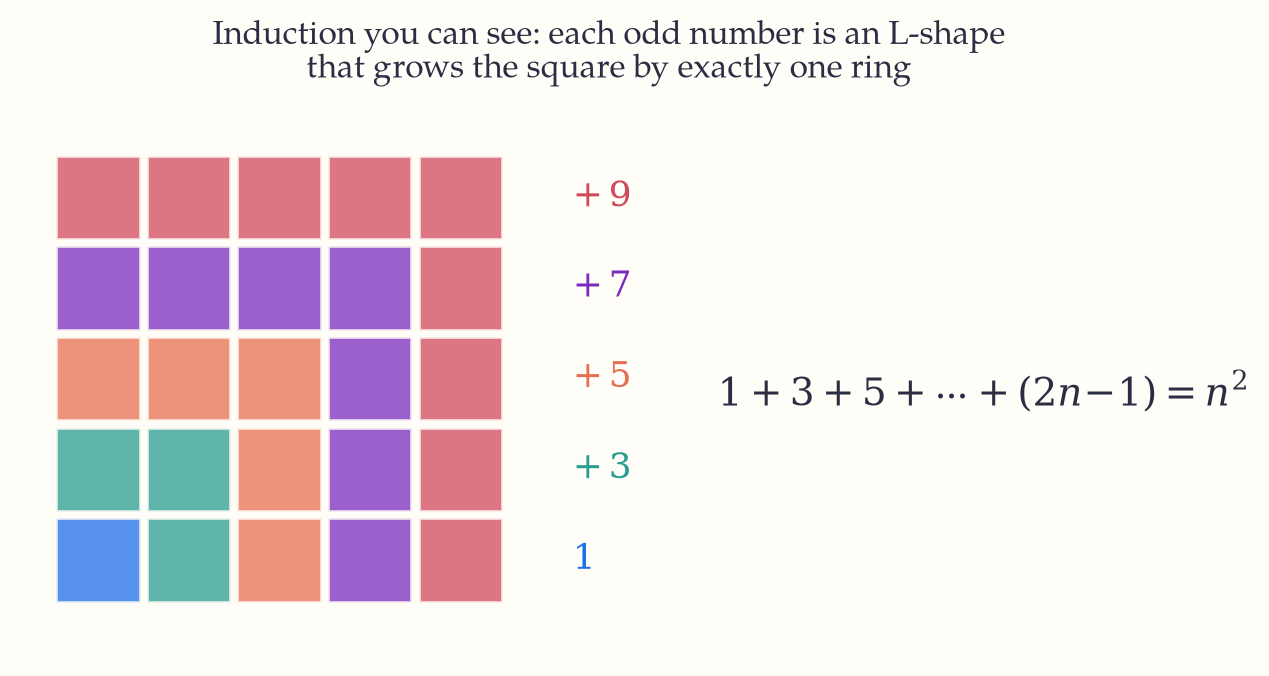
And sometimes an induction can simply be seen — here is Exercise 2.6’s claim, that the odd numbers sum to perfect squares, as a picture in which each odd number is the L-shaped ring that grows the square by one:
In the wild. Induction is the mathematics of recursion. Proving a recursive function correct, or bounding an algorithm’s running time, is an induction proof — base case = the recursion’s base case, inductive step = the recursive call. Computer science quietly runs on Chapter 2.
If you keep one thing from this chapter: An equation is a balance: do the same to both sides. Factoring solves because only zero annihilates a product — and induction fells infinitely many dominoes with just two moves.
Exercises 2
- Factor completely: (a) x^2 - 5x + 6 (b) 4x^2 - 25 (c) x^3 - 8.
- Solve the system 3x + 2y = 7, 5x - 2y = 1.
- Solve the inequality \dfrac{x-1}{x+2} \ge 0 (careful near x = -2).
- If x + \frac{1}{x} = 4, find x^2 + \frac{1}{x^2} without finding x.
- A rectangle’s length exceeds its width by 3, and its area is 40. Find its dimensions.
- Prove by induction that 1 + 3 + 5 + \cdots + (2n-1) = n^2 — the sum of the first n odd numbers is a perfect square. (Picture it too: each new odd number wraps an L-shape around the previous square.)
In the wild. Every line of code that says
total = price * qty * (1 - discount)is algebra; every spreadsheet is a sheet of live formulas; every physics engine solves equations thousands of times per second. Symbolic manipulation is also what computer-algebra systems (SymPy, Mathematica) automate — but they only help if you can read what they return.
Checkpoint Review I — Foundations
Cumulative, Chapters 1–2. Mixed on purpose: retrieval out of context is the test that counts. Do all eight cold, then check below; a miss names the section to revisit.
- Place in increasing order: 0.7, \frac{5}{7}, \sqrt{0.5}, 0.71.
- A price drops 30% to Rs. 210. What was the original price?
- Simplify \dfrac{x^2 - 9}{x^2 + x - 6}.
- Solve x^2 = 5x. (Careful — a classic trap.)
- Evaluate \left(\frac{1}{8}\right)^{-2/3}.
- Solve \dfrac{2}{x-1} = \dfrac{3}{x+1}.
- Two numbers sum to 20 and differ by 6. Find them.
- Prove by induction that 2^n > n for every natural number n.
Answers. 1. \sqrt{0.5} \approx 0.7071 and \frac57 \approx 0.7143, so 0.7 < \sqrt{0.5} < 0.71 < \frac{5}{7}. 2. 0.7x = 210 \Rightarrow Rs. 300 (not 210 \times 1.3!). 3. \frac{(x-3)(x+3)}{(x+3)(x-2)} = \frac{x-3}{x-2} (x \ne -3). 4. x^2 - 5x = 0 \Rightarrow x(x-5) = 0 \Rightarrow x = 0 or 5 — dividing by x silently discards the root 0. 5. 8^{2/3} = 4. 6. Cross-multiply: 2x + 2 = 3x - 3 \Rightarrow x = 5. 7. 13 and 7. 8. Base: 2^1 = 2 > 1. Step: 2^{n+1} = 2\cdot2^n > 2n \ge n+1 for n \ge 1. \blacksquare