Preface
You once knew this. That is the premise of this book, and it changes everything about how it is written.
A first course must build slowly, because the ideas are new. A refresher can move differently: it can go straight for the heart of each idea, remind you of the picture that makes it obvious, and trust that the details will come flooding back — because they are still in there, filed away under a thin layer of dust.
So this book is organized around pictures and reasons, not procedures. Almost every important idea in mathematics up to a bachelor’s degree can be seen: a derivative is a tangent line sliding into place, a logarithm is an exponential reflected in a mirror, an eigenvector is the one direction a transformation refuses to turn. When you can see an idea, you cannot really forget it — you can only misplace it. This book’s job is to help you find it again.
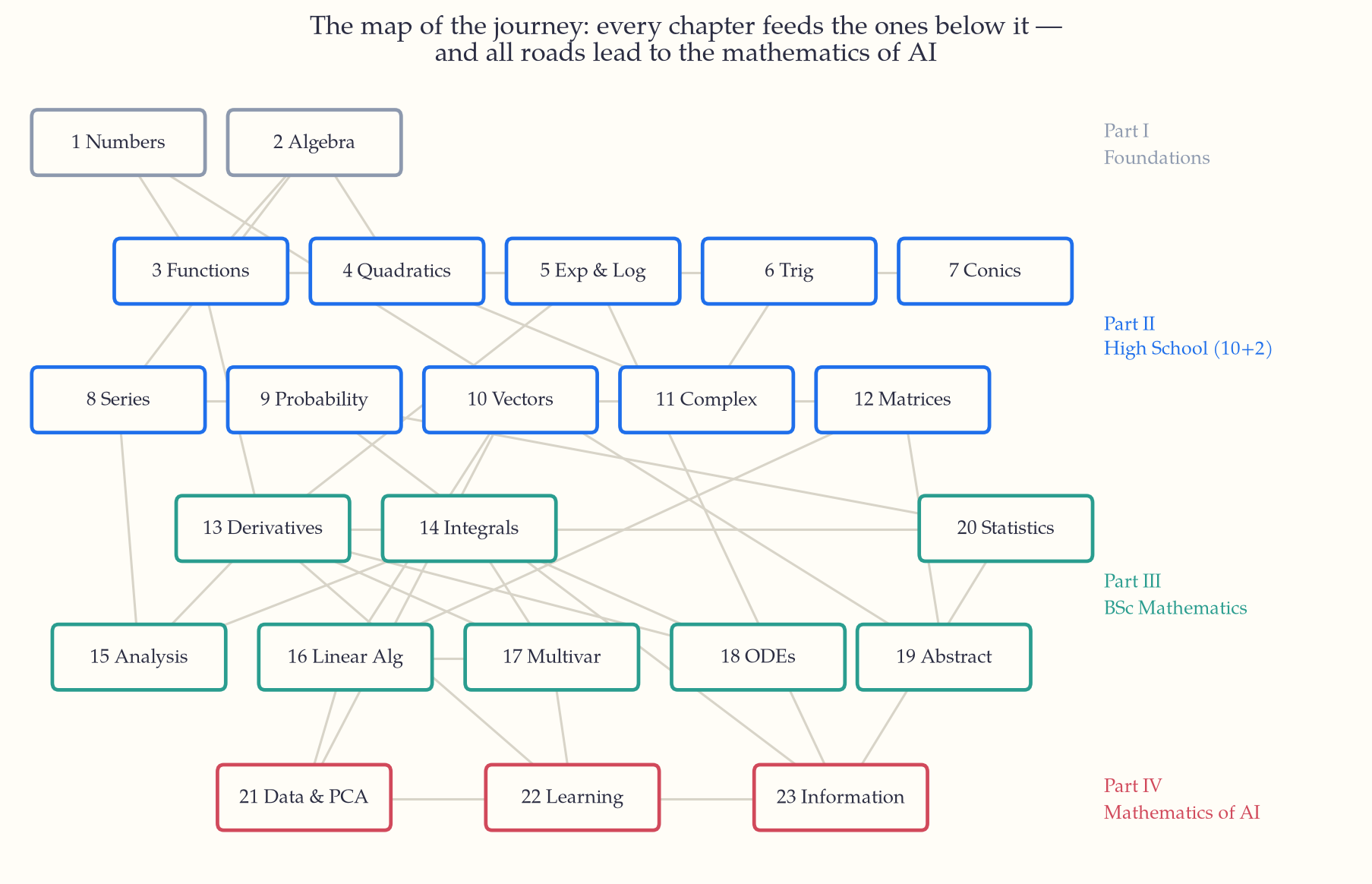
How to read it. Part I rebuilds the ground floor: numbers and algebra. Part II walks through the whole of school mathematics up to 10+2 — functions, trigonometry, coordinate geometry, probability, vectors, complex numbers, matrices, and a first pass at calculus. Part III lifts off into BSc territory: real analysis, linear algebra, multivariable calculus, differential equations, abstract algebra, and probability theory. Part IV then turns the whole edifice towards artificial intelligence — data as vectors, learning as descent along a gradient, and loss as the logarithm of a likelihood — showing that the mathematics behind modern machine learning is the mathematics the first three parts just restored. Each chapter ends with a short set of exercises; worked answers are collected at the back. Do the exercises with a pen. Mathematics read is mathematics forgotten; mathematics written is mathematics owned.
Interactive companion. This book has a free companion app: a chapter-by-chapter playground with one interactive explorer for every chapter. Drag a tangent line along a curve, watch Riemann rectangles melt into an integral, run gradient descent, spin the unit circle, build Taylor series term by term, simulate the Central Limit Theorem. Whenever a figure here makes you want to touch the mathematics, open the matching chapter there.
About this book. This book was written by Abdul Qabiz and co-authored with AI: Anthropic’s Claude Fable and Claude Opus drafted, illustrated, and checked much of the material under direction. Every numerical answer was verified by computer before printing, and the manuscript went through several review passes — but errors will have survived, as they do in every first edition. If you find one, whether a wrong answer, a muddled explanation, or a figure that misleads, please report it at abdulqabiz.com/blog so it can be corrected in the next edition.
A note on rigor. In Parts I and II we argue the way good school teachers do: honestly, but with pictures doing much of the work. In Parts III and IV we show you what professional rigor looks like — the \varepsilon–\delta definition, the axioms of a group — because the whole point of a mathematics degree is learning that the pictures, lovely as they are, must eventually be backed by proof.
A promise about worked solutions. Textbooks for people who already know the material love to write “it follows that” and skip four lines of algebra. This book does not. Every worked example is narrated one step at a time, with the reason for each step alongside the step itself — because the reader who has forgotten calculus has usually forgotten precisely those connecting moves, not the headline formulas. When a solution here seems slow, that is the point: slow once, so it can be fast forever after. And a companion habit we will keep urging: verify backwards. An antiderivative can be checked by differentiating; a solved equation by substituting the answer back in. Mathematics is the rare subject that grades its own homework — use that.
Making it stick: the retention protocol. Understanding fades on a schedule; so must review. This book is built for a specific rhythm, and following it is the difference between “I read that” and “I know that”:
- Same day — read a chapter, then immediately do its Drills (Appendix B): six quick mechanical problems per chapter, answers inline. Drills build hand speed; the chapter built understanding; you need both.
- End of chapter — do the chapter’s main Exercises, then compare your working with the full solutions in Appendix A. Attempt the \star Challenge in the Drill Bank if you have appetite; skip guiltlessly if not.
- Part boundaries — four cumulative Checkpoint Reviews are placed at natural resting points — after Chapters 2, 8, 14 and 20. They deliberately mix earlier chapters, because retrieving an idea in an unexpected context is what welds it in. Score yourself honestly; any miss names the chapter to revisit.
- One week later, then one month later — redo (from a blank page) the worked examples of the chapters you found hardest. Rederiving the quadratic formula or re-running a substitution integral from memory takes ten minutes and is worth more than three hours of rereading.
That is the whole system: read, drill, exercise, checkpoint, and two spaced returns. It is deliberately light — a protocol you will actually follow beats an ideal one you won’t.
And here, before setting out, is the whole journey on one page — the chapters as a map, each feeding those below it:
Take your time. The mathematics will wait for you; it has been waiting all along.