Sequences, Series, and the Binomial Theorem
Arithmetic and geometric progressions#
A sequence is an ordered list a_1, a_2, a_3, \dots; a series is what you get when you dare to add it up. Two families do most of the world’s work:
Arithmetic (AP): each term adds a fixed difference d. \begin{aligned}a_n = a + (n-1)d, \\ S_n = \frac{n}{2}\big(2a + (n-1)d\big) = \frac{n}{2}(\text{first} + \text{last}).\end{aligned}
The sum formula is Gauss’s schoolboy trick: write the sum forwards and backwards, add the two rows — every column gives the same total.
Geometric (GP): each term multiplies by a fixed ratio r. \begin{aligned}a_n = ar^{n-1}, \\ S_n = a\,\frac{1 - r^n}{1 - r} \\ (r \ne 1).\end{aligned}
When |r| < 1, the powers r^n wither to zero and something remarkable happens — infinitely many numbers add to a finite total:
S_\infty = \frac{a}{1 - r}.
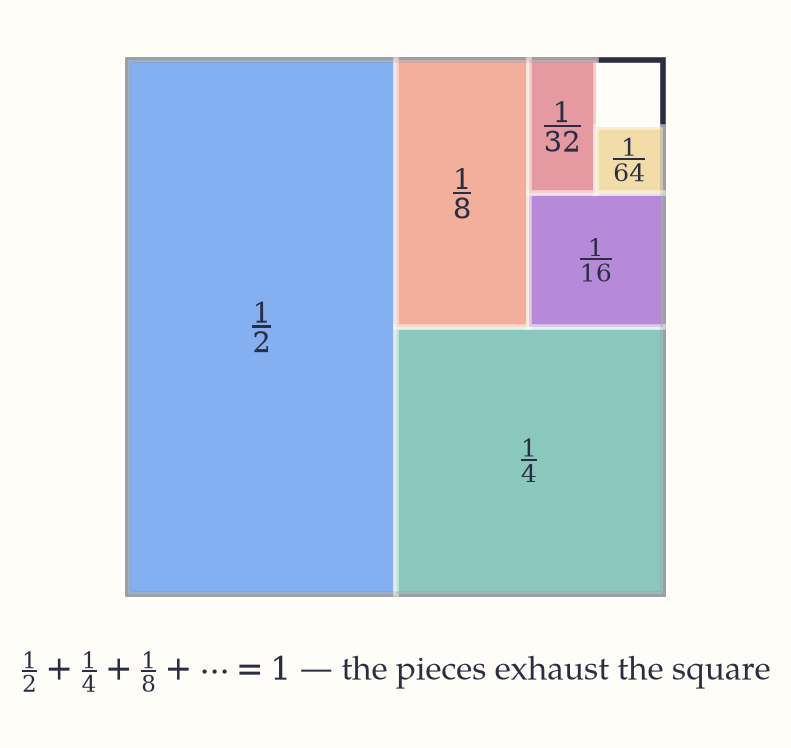
The picture is the proof for \frac12 + \frac14 + \frac18 + \cdots = 1: each new piece fills half of what remains, and the whole square gets exhausted. This resolves Zeno’s ancient paradox — infinitely many steps can take finite time.
The binomial theorem#
Expanding (a+b)^n by brute force is misery; counting is the shortcut. Each term in the expansion comes from choosing b from k of the n brackets, and the number of ways to do that is the binomial coefficient \binom{n}{k} = \frac{n!}{k!(n-k)!}:
(a+b)^n = \sum_{k=0}^{n} \binom{n}{k} a^{n-k}b^k.
One expansion done slowly is worth more than the general formula stared at. Take (2x - 3)^4, which has both a coefficient and a minus sign to trip over:
\begin{aligned}(2x-3)^4 &= \sum_{k=0}^{4}\binom{4}{k}(2x)^{4-k}(-3)^k \\ &\quad \text{here } a=2x \text{ and } b=-3 \text{ — sign included in } b \\ \binom{4}{k} &= 1,\ 4,\ 6,\ 4,\ 1\end{aligned}
row 4 of Pascal’s triangle
\begin{aligned}&= 1(2x)^4 + 4(2x)^3(-3) + 6(2x)^2(9) + 4(2x)(-27) + 81\end{aligned}
term by term
\begin{aligned}&= 16x^4 - 96x^3 + 216x^2 - 216x + 81. \\ &\quad \text{signs alternate, because } b<0\end{aligned}
Two habits worth keeping. Fold the minus sign into b at the start rather than patching signs at the end, and raise the whole of 2x to the power, not just the x — those two slips account for most wrong binomial expansions.
The coefficients form Pascal’s triangle — each entry the sum of the two above it:
\begin{matrix} &&&&1&&&&\\ &&&1&&1&&&\\ &&1&&2&&1&&\\ &1&&3&&3&&1&\\ 1&&4&&6&&4&&1 \end{matrix}
So (a+b)^4 = a^4 + 4a^3b + 6a^2b^2 + 4ab^3 + b^4, no multiplication required. The same coefficients will return in Chapter 9 as counting problems, and in Chapter 20 as the binomial probability distribution — one of mathematics’ best recurring characters.
If you keep one thing from this chapter: An infinite series is the limit of its partial sums, and it converges only when the tail dies — for geometric series, exactly when |r| < 1.
Exercises 8
- The 5th term of an AP is 14 and the 12th is 35. Find the first term, common difference, and S_{20}.
- Evaluate \sum_{k=1}^{60} (3k - 1).
- A ball drops from 10 m and rebounds to \frac{2}{3} of each fall. Find the total distance it travels.
- Find the coefficient of x^3 in (2 - x)^7.
- For what values of x does 1 + (x-2) + (x-2)^2 + \cdots converge, and to what?
In the wild. Compound interest is a GP in money’s clothing; a loan EMI formula is a finite geometric sum solved for the payment. In computer science, the analysis of algorithms leans on these sums constantly — the total work of repeated halving, n + \frac{n}{2} + \frac{n}{4} + \cdots < 2n, is why many divide-and-conquer algorithms are fast. And the discounted-reward sum \sum_t \gamma^t r_t at the heart of reinforcement learning is an infinite GP with ratio \gamma < 1.
Checkpoint Review II — Functions to Series
Cumulative, Chapters 3–8, with roots reaching back to Part I.
- Find the domain of f(x) = \ln(x - 2).
- Solve x^2 - 6x + 9 = 0 and interpret the answer’s multiplicity graphically.
- Simplify \log_2 40 - \log_2 5.
- Evaluate exactly: \sin\frac{\pi}{4}\cos\frac{\pi}{4}.
- Find the line through (0, 3) parallel to y = 2x - 1.
- Find the equation of the circle with center (3,4) passing through the origin.
- Compute \sum_{k=1}^{10} 2^k.
- A 5 m ladder leans against a wall with its foot 3 m out. How high does it reach, and what angle does it make with the ground?
Answers. 1. x > 2. 2. (x-3)^2 = 0: the double root x = 3 — the parabola kisses the axis (\Delta = 0). 3. \log_2 8 = 3. 4. \frac{\sqrt2}{2}\cdot\frac{\sqrt2}{2} = \frac12 (also visible as \frac12\sin\frac{\pi}{2} via the double angle). 5. Same slope: y = 2x + 3. 6. Radius = \sqrt{9+16} = 5: (x-3)^2 + (y-4)^2 = 25. 7. Geometric: 2^{11} - 2 = 2046. 8. Height = \sqrt{25-9} = 4 m; angle = \arccos\frac{3}{5} \approx 53.1° — Pythagoras and inverse trig shaking hands.