Numbers: The Raw Material
The great tower of number systems#
Mathematics begins with a sequence of ever-braver answers to the question “what counts as a number?”
| Set | Symbol | Contains | Invented to solve |
|---|---|---|---|
| Natural numbers | \mathbb{N} | 1, 2, 3, \dots | counting |
| Integers | \mathbb{Z} | \dots,-2,-1,0,1,2,\dots | x + 5 = 3 |
| Rationals | \mathbb{Q} | all fractions p/q | 3x = 2 |
| Reals | \mathbb{R} | rationals and irrationals | x^2 = 2 |
| Complex | \mathbb{C} | a + bi with i^2 = -1 | x^2 = -1 |
Each set sits inside the next: \mathbb{N} \subset \mathbb{Z} \subset \mathbb{Q} \subset \mathbb{R} \subset \mathbb{C}. (That \subset symbol, and a handful of its friends, form mathematics’ shorthand for talking about collections — worth thirty seconds to re-fix, since everything later uses them. A set is a collection of objects: x \in S means “x belongs to S”; A \subset B means every member of A is in B; A \cup B is the merger (“union”: in either), A \cap B the overlap (“intersection”: in both); \{x : x > 0\} is set-builder notation, “the set of all x such that x > 0”; and \emptyset is the empty set. Intervals are sets too: [a, b] includes its endpoints, (a, b) excludes them.) Every expansion was controversial in its day — negative numbers were called “absurd”, irrationals scandalized the Pythagoreans, and “imaginary” was originally an insult. Every one of them is now indispensable.
The real numbers are best pictured as a line: every real number is a point, every point is a real number, with no gaps anywhere. That gaplessness (the completeness of \mathbb{R}) sounds like a technicality now, but in Part III it will turn out to be the foundation on which all of calculus rests.
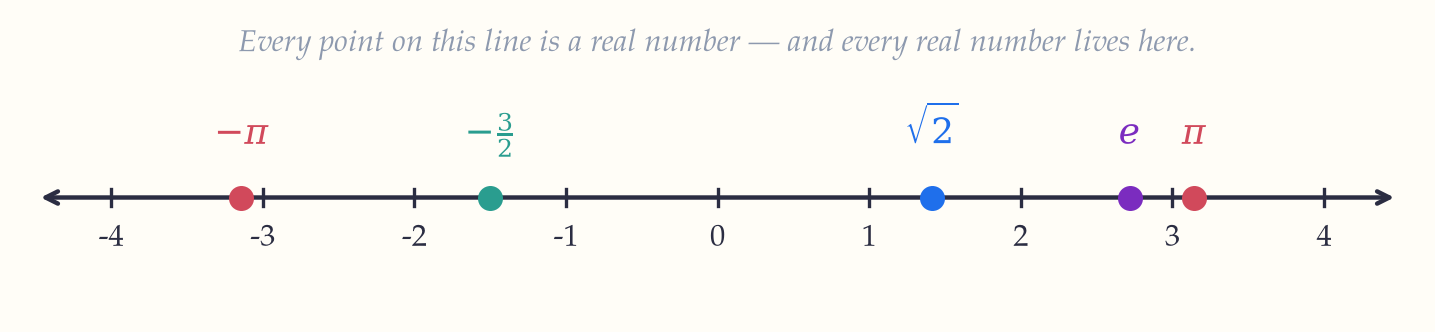
A number like \sqrt{2} = 1.41421356\dots is irrational: its decimal expansion never terminates and never repeats, and it cannot be written as a fraction of integers. The classic proof is a gem worth re-savoring: suppose \sqrt{2} = p/q in lowest terms. Then p^2 = 2q^2, so p^2 is even, so p is even, say p = 2k. Then 4k^2 = 2q^2, so q^2 = 2k^2, so q is even too — contradicting “lowest terms.” Hence no such fraction exists. \blacksquare
Fractions, decimals, percentages: one idea in three costumes#
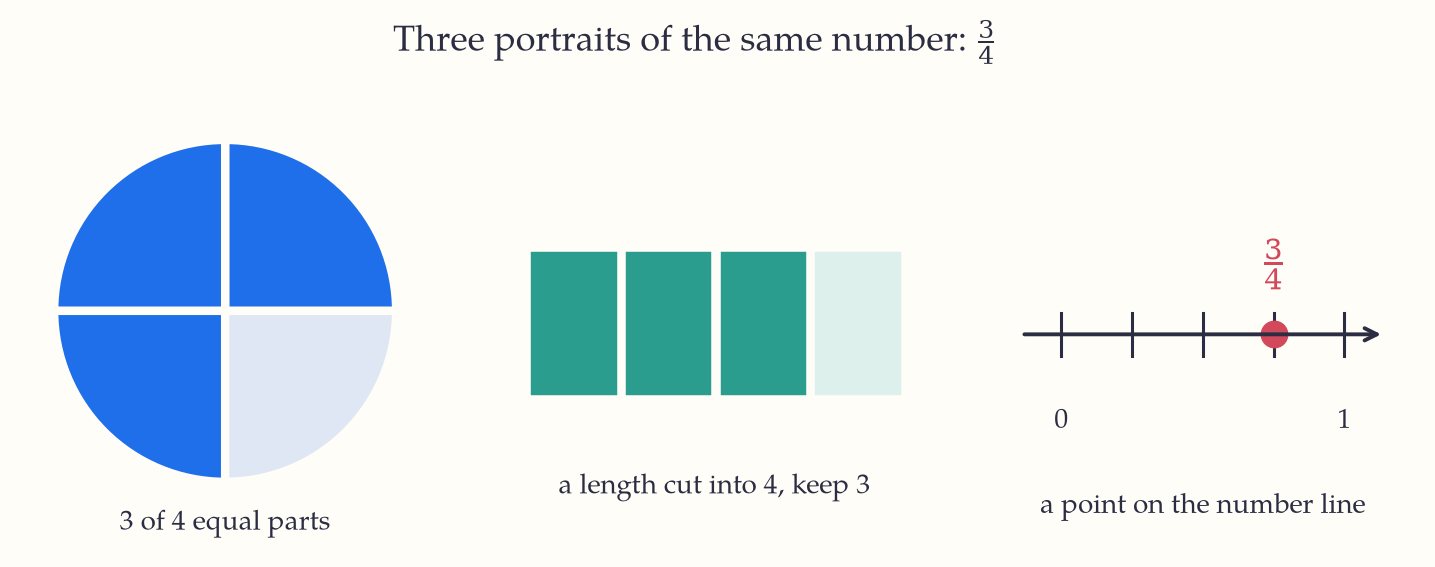
A fraction \frac{3}{4} is simultaneously a part of a whole, a point on the line, and a division waiting to happen (3 \div 4 = 0.75). Percentages are just fractions with denominator 100: 75\% = \frac{75}{100} = 0.75. Fluency means moving between the costumes without thinking.
The arithmetic rules, with the reasons attached:
- Adding needs a common denominator, because you can only add like things: \dfrac{a}{b} + \dfrac{c}{d} = \dfrac{ad + bc}{bd}. (You are re-cutting both cakes into bd slices.)
- Multiplying is “a fraction of a fraction”: \dfrac{a}{b} \cdot \dfrac{c}{d} = \dfrac{ac}{bd}.
- Dividing asks “how many of these fit in that?” — hence flip and multiply: \dfrac{a}{b} \div \dfrac{c}{d} = \dfrac{a}{b} \cdot \dfrac{d}{c}.
Key idea. “Of” means multiply. 40\% of 250 is 0.40 \times 250 = 100. A 15\% increase is multiplication by 1.15; a 15\% decrease is multiplication by 0.85. Two successive 10\% increases are \times 1.1 \times 1.1 = \times 1.21 — a 21\% rise, not 20\%. Percentages compound; they do not add.
Worked examples. (1) A laptop marked Rs. 64,000 is discounted 15%, then 18% GST is added: 64000 \times 0.85 \times 1.18 = Rs.\ 64{,}192 — almost exactly the sticker price, because 0.85 \times 1.18 = 1.003: the discount and the tax nearly cancel. (2) A stock falls 50% then rises 50%: \times 0.5 \times 1.5 = 0.75 — still down 25%. Losses need bigger percentage gains to repair.
Powers, roots, and the laws of exponents#
a^n means n copies of a multiplied. From that one meaning, all the laws follow:
\begin{aligned}a^m \cdot a^n = a^{m+n}, \\ \frac{a^m}{a^n} = a^{m-n}, \\ (a^m)^n = a^{mn}.\end{aligned}
The definitions of zero, negative, and fractional exponents are not arbitrary decrees — they are the only choices that keep those laws true:
\begin{aligned}a^0 = 1, \\ a^{-n} = \frac{1}{a^n}, \\ a^{1/n} = \sqrt[n]{a}, \\ a^{p/q} = \left(\sqrt[q]{a}\right)^{p}.\end{aligned}
Watch the machinery on one expression, simplifying \dfrac{(8x^3)^{2/3}}{2x^{-1}}:
\begin{aligned}(8x^3)^{2/3} &= 8^{2/3}\,(x^3)^{2/3}\end{aligned}
the power spreads over the product
\begin{aligned}&= \left(\sqrt[3]{8}\right)^2 \cdot x^{2} = 4x^2\end{aligned}
cube root first, then square — smaller numbers
\begin{aligned}\frac{4x^2}{2x^{-1}} &= 2\,x^{2-(-1)} = 2x^3\end{aligned}
dividing subtracts exponents; a double negative
The one to watch is the last line: subtracting a negative exponent adds. For instance a^0 must be 1 because a^n \cdot a^0 = a^{n+0} = a^n. Mathematics extends its definitions the way a good lawyer extends a contract: preserving every clause already agreed.
In the wild. Your computer stores reals in floating point — essentially scientific notation \pm m \times 2^e with a fixed budget of digits — which is why
0.1 + 0.2 != 0.3in most programming languages: 0.1 has an infinite binary expansion, just as \frac{1}{3} has an infinite decimal one. And integer arithmetic done modulo huge primes (remainders after division) is the engine of all modern cryptography; Chapter 19 explains why primes make it work.
Order of operations#
BODMAS/PEMDAS is merely a punctuation convention: Brackets, then Orders (powers and roots), then Division/Multiplication left to right, then Addition/Subtraction left to right. So
3 + 4 \times 2^2 = 3 + 4 \times 4 = 3 + 16 = 19.
If you keep one thing from this chapter: Every extension of “number” — negatives, fractions, irrationals, complex — was forced by an equation the old numbers couldn’t solve. And percentages multiply; they never add.
Exercises 1
- Place -\frac{7}{3}, \sqrt{5}, 2.4, and -\sqrt{2} in increasing order.
- Simplify \dfrac{2}{3} + \dfrac{3}{4} \div \dfrac{1}{2}.
- A price rises 20% then falls 20%. What is the overall percentage change?
- Evaluate 8^{2/3}, 5^{-2}, and \left(\frac{1}{4}\right)^{-3/2} without a calculator.
- Prove that \sqrt{3} is irrational, imitating the proof for \sqrt{2}.